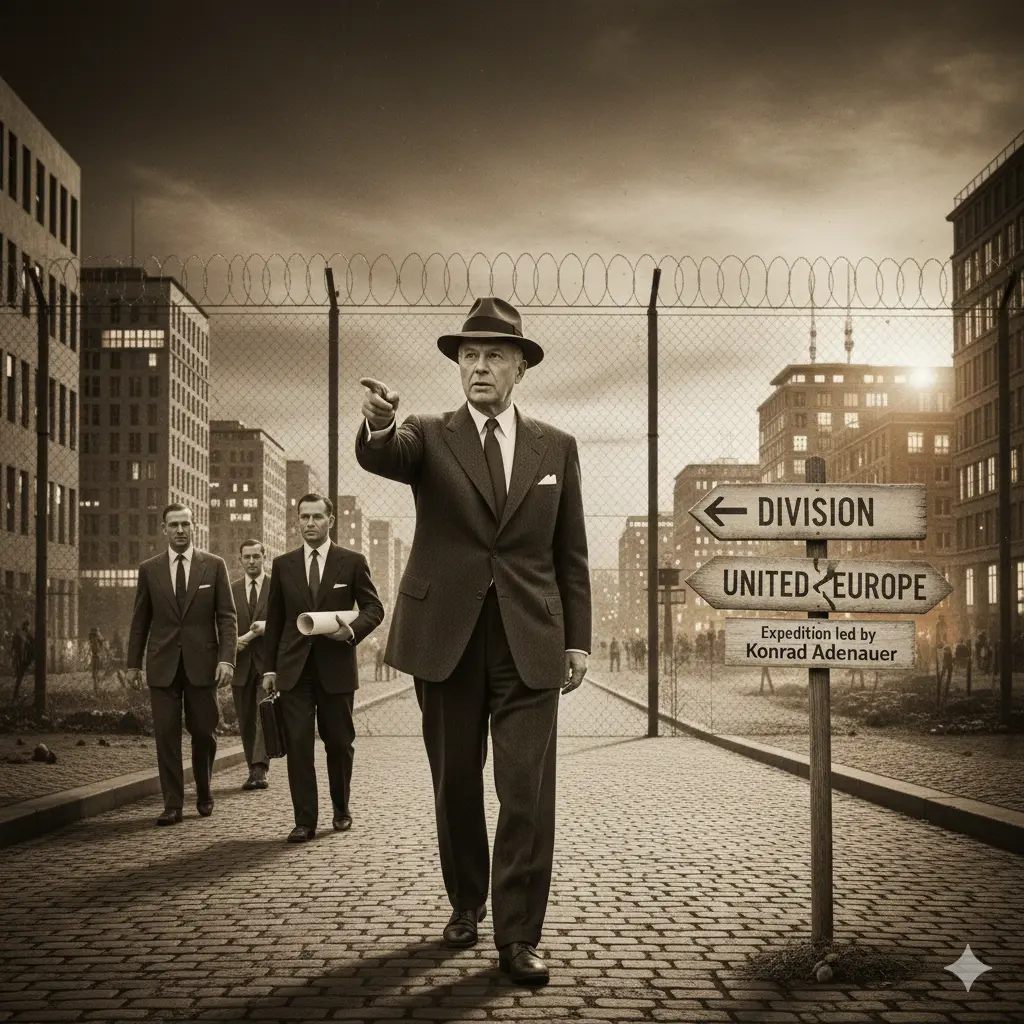
The Iron Curtain: From Division to a United Europe
We survived the catastrophe and dreamed of a different future. This journey explores the two Europes that emerged from the war: one chained by ideology, the other seeking unity.
📍 Berlin, Europe · 🗓 Summer & Winter 2027 · 🗣 English

🏛️ Your historical guide
We survived the catastrophe and dreamed of a different future. This journey explores the two Europes that emerged from the war: one chained by ideology, the other seeking unity. We will see the Wall, symbol of division, and the places where the European Union was born, symbol of hope.
Who runs this program
This itinerary is new, our track record is not. These are testimonials from participants in our executive programs in Vienna, translated from Spanish.
It is fascinating how the tools help solve real problems.
 Billy Batware United Nations Regional Academy
 An excellent organization that gives you a great opportunity to live this magnificent experience, gain knowledge and make new friends.
 Marcela Mejía United Nations Office on Drugs and Crime, Colombia
 Thank you for all the tools and lessons, a hands-on program where I met wonderful people.
 Natalia Lever The Climate Reality Project Latin America
 Institutions and organizations we have worked with







🎯 Why this journey
Why it matters
This journey explores the history of Europe from its lowest point of division (the Cold War) to its greatest achievement: the creation of the European Union. It is a story of reconciliation, long-term vision, and the building of supranational institutions to safeguard peace.
What you'll learn
You will understand the logic of the Cold War division in Berlin and, in contrast, the founding principles of the EU in Rome and Brussels. You will analyze the world's greatest experiment in multilevel governance and the importance of economic cooperation in achieving political peace.
Relevance
The ability to build alliances, negotiate in multicultural settings, and lead long-term projects is essential. This journey is a masterclass for leaders in the public and private sectors, diplomats, and strategists on how to turn vision into lasting institutions.
✨ Highlights
- Guided 10-day itinerary
- Small group (max. 22 participants)
- Curated pre-work: 2 resources
- Group discounts available
🗺️ Itinerary
Arrival in Berlin. We will walk along the East Side Gallery, the longest preserved stretch of the Berlin Wall. We will visit Checkpoint Charlie and the Wall Memorial to understand life in a city split in two.
↳ Berlin was the heart and the most tangible symbol of the Cold War. Walking along the Wall is to feel the physical and ideological scar that divided Europe and the world for nearly half a century.
We will visit the Berlin Airlift monument at the former Tempelhof airport. In the afternoon, a spy-war tour will take us to the Glienicke Bridge, the "bridge of spies," to discuss the secret world of the CIA and the KGB.
↳ The Airlift was the West's first great victory of the Cold War. Espionage, for its part, was the invisible front. This day shows us the two faces of the conflict: the public and the secret.
We will immerse ourselves in the everyday life of East Germany at the interactive GDR Museum. From Trabant cars to prefabricated apartments and Stasi surveillance, it is a fascinating look at a vanished world.
↳ To understand why the Wall fell, you have to understand what life was like behind it. This museum offers a human, and often surreal, perspective on life under communism.
Flight to Prague. We will visit Wenceslas Square, the epicenter of the 1968 "Prague Spring," the attempt to create a "socialism with a human face" that was crushed by Soviet tanks. A dissident from that era will share their testimony.
↳ Prague represents the hope of reform within the Eastern bloc and the brutal reality of the Brezhnev Doctrine. It is key to understanding that opposition to the system came not only from outside, but from within as well.
Flight to Rome. We will make our way to the Capitoline Hill, to the Hall of the Horatii and Curiatii, where the Treaty of Rome was signed in 1957, creating the European Economic Community. An expert in European studies will explain the vision of the founding fathers.
↳ While Berlin was dividing, Rome was uniting. The signing of this treaty was a revolutionary act of peace and pragmatism, the first step toward making a future war between European nations "not only unthinkable, but materially impossible."
A seminar on the "Founding Fathers of Europe," such as Robert Schuman and Jean Monnet. We will analyze the 1950 Schuman Declaration and the brilliant idea of beginning integration through coal and steel, the industries of war.
↳ The genius of the European project lies in its method. It did not begin with grand speeches, but with a practical, sector-by-sector plan. It is a masterclass in incremental strategy for achieving an ambitious goal.
Flight to Brussels. We will visit the "European Quarter," home to the European Commission and the European Parliament. At the Parlamentarium, an interactive visitor center, we will explore how the European Union works today.
↳ Brussels is the de facto capital of the EU. Understanding its institutions is key to grasping how 27 sovereign nations collaborate, legislate, and negotiate in a political project unique in history.
Return to Berlin. We will follow the chronology of the night the Wall fell, from the press conference that set it off to the mass crossing at the Bornholmer Straße bridge. An evening to celebrate freedom and reunification.
↳ The fall of the Wall was a spontaneous, seismic event that marked the end of the Cold War. To relive that night is to celebrate the power of the people and the collapse of a system built on repression.
An expert will speak to us about the enormous economic and social challenges of German reunification. We will visit neighborhoods of the former East Berlin to see the transformation and the problems that still persist.
↳ Reunification was not merely a political act, but a long and costly process. Analyzing it teaches us about managing large-scale transitions and integrating very different systems.
A visit to the Brandenburg Gate, now a symbol of a reunified Germany and Europe. A final reflection on today's challenges and the future of the European project. Farewell lunch and transfer to the Berlin airport.
↳ The journey concludes by looking to the future. From division to unity, the history of Europe in the second half of the twentieth century is one of resilience and constant challenges. We leave asking ourselves: what comes next for Europe?
📚 Diplomatic Archives
- Book Postwar: A History of Europe Since 1945, Tony Judt
- Film The Lives of Others, Florian Henckel von Donnersmarck
Your complete experience
✓ What's included
- Accommodation in charming, well-located hotels.
- All breakfasts and the lunches or dinners specified in the itinerary.
- Expert guides and historians throughout the journey.
- Entrance to all museums, monuments and historic sites in the itinerary.
- Comfortable private transport for all transfers between cities and activities.
- Exclusive workshops, tastings and immersive experiences described in the program.
- A welcome pack with reading materials and a travel journal.
- Basic travel insurance.
✕ Not included
- Round-trip international flights to the expedition start/end point.
- Meals and drinks not specified in the itinerary.
- Personal expenses, purchases and souvenirs.
- Optional activities during free time.
- Tips (optional).
Travelling on your own?
Join the list for the departure you want
These programs run as groups, so we do not sell individual seats. Leave your details for the departure you are interested in: once the group is confirmed we introduce you to the local organizer, who handles registration.
🧭 How it works
Tell us your goal
Message us with your organization, focus area and approximate dates.
We tailor it
We adapt the itinerary, cities, language and group size. Private groups available.
Confirm and travel
We handle logistics, certificates and materials; your team lives the experience.