
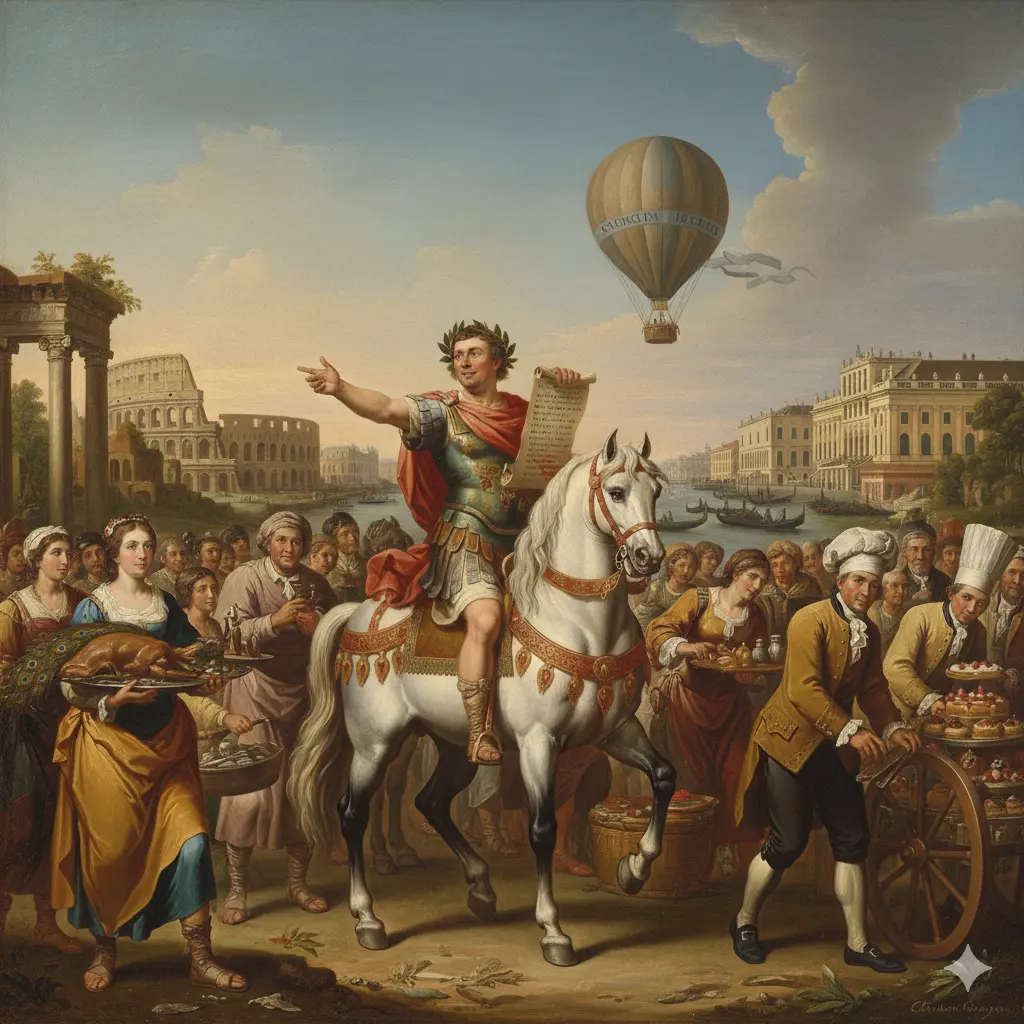
Flavors of the Empire: From Rome to Vienna
Join me at a banquet across time. We will follow the ancient trade routes that carried spices and recipes from the heart of Rome to the far reaches of the Holy Roman Empire.
📍 Rome, Europe · 🗓 Summer & Winter 2027 · 🗣 English

🏛️ Your historical guide
Join me at a banquet across time. We will follow the ancient trade routes that carried spices and recipes from the heart of Rome to the far reaches of the Holy Roman Empire. We will discover how the fall of one empire and the birth of new ones transformed the ingredients and the tables of Europe. This is a journey for the stomach and for the mind.
Who runs this program
This itinerary is new, our track record is not. These are testimonials from participants in our executive programs in Vienna, translated from Spanish.
It is fascinating how the tools help solve real problems.
 Billy Batware United Nations Regional Academy
 An excellent organization that gives you a great opportunity to live this magnificent experience, gain knowledge and make new friends.
 Marcela Mejía United Nations Office on Drugs and Crime, Colombia
 Thank you for all the tools and lessons, a hands-on program where I met wonderful people.
 Natalia Lever The Climate Reality Project Latin America
 Institutions and organizations we have worked with








🎯 Why this journey
Why it matters
This trip traces a fascinating culinary route that follows the expansion and transformation of the empires of Europe. From the recipes of ancient Rome to the opulence of imperial Vienna, food acts as a historical record of cultural influences, trade, and power.
What you'll learn
You will understand how gastronomy evolves across borders and centuries. You will learn to identify Roman influences in Italian cooking, the transition to hearty Germanic cuisine, and how the diversity of a multicultural empire like the Austro-Hungarian is reflected at its table.
Relevance
The ability to understand how a product evolves and adapts to different markets is crucial. This trip offers lessons in supply-chain logistics, cultural adaptation, and product history, highly relevant to professionals in food, logistics, and international business.
✨ Highlights
- Guided 10-day itinerary
- Small group (max. 16 participants)
- Curated pre-work: 2 resources
- Group discounts available
🗺️ Itinerary
Benvenuti a Roma. Our first dinner will be in the Testaccio neighborhood, the ancient logistical and gastronomic center of the Roman Empire. In a historic trattoria, we will sample dishes of Roman "cucina povera" such as cacio e pepe or coda alla vaccinara, understanding their humble origins.
↳ Testaccio connects us directly to the belly of ancient Rome. To eat here is to taste history, dishes that have evolved over centuries yet preserve the soul of Rome's popular cuisine.
We will explore the vibrant Campo de' Fiori market. In the afternoon, we will take part in a unique cooking class, recreating recipes from Apicius's book "De re coquinaria," adapted for the modern palate. We will discover the use of ingredients such as "garum" and exotic spices.
↳ Cooking recipes from ancient Rome is a form of experimental archaeology. It lets us understand the flavors, the techniques, and the sophistication of a civilization too often remembered only for its legions.
Train journey to Bologna, the gastronomic capital of Italy. In the afternoon, we will take a walking tour of the "Quadrilatero," the medieval market district, overflowing with fresh pasta, mortadella, and Parmigiano Reggiano. Dinner will be at a classic osteria, with a plate of authentic "tagliatelle al ragù."
↳ Bologna, "the Fat One," is the heart of the Italian pantry. Here, food is a science and a religion. We will understand why its cuisine, built on the richness of its produce, has become a global standard.
A day trip to the Modena region. In the morning, we will visit an "acetaia" to unravel the secrets of Aceto Balsamico Tradizionale, with a tasting of 12- and 25-year-old vinegars. After lunch, we will visit a Parmigiano Reggiano producer to see the process from milk to wheel. And a stop in Maranello for Ferrari lovers could not be missing.
↳ Balsamic and Parmesan are two of the most imitated culinary treasures in the world. Learning about their artisanal, traditional production is a lesson in the importance of time, patience, and denomination of origin.
A scenic train journey across the Alps to Munich. To contrast with Italian cuisine, we will spend our first Bavarian night in a historic brewery (Hofbräuhaus or similar), sampling giant pretzels, pork knuckle, and, of course, local wheat beer, all with traditional music.
↳ Crossing the Alps is not just a change of scenery, it is a culinary transition. From the lightness of olive oil to the heartiness of lard; from the subtlety of wine to the celebration of beer. It is the gastronomic frontier of Europe.
In the morning, a "sausage tour" will take us through the Viktualienmarkt to try different kinds of Bavarian "würste." In the afternoon, we will relax like locals in one of the "Biergärten" (beer gardens) of the English Garden, taking in the culture of open-air beer.
↳ Beer and sausages are the soul of Bavarian culture. This day teaches us that food can be a pillar of social and community life, bringing people together in shared celebration.
Train journey to Vienna. Our first immersion in the Habsburg capital will be at a traditional Viennese café, a UNESCO heritage tradition. We will order a "melange" and a slice of Sacher torte or Apfelstrudel while a local historian tells us about coffeehouse culture as the center of intellectual and artistic life.
↳ The Viennese café is an institution, a "public salon" where revolutionary ideas in music, art, and psychology were born. It is a place to see and be seen, to read the newspaper and to debate, a microcosm of imperial Vienna.
We will take part in a cooking class to learn how to prepare the perfect Wiener Schnitzel. Lunch will be our own creation. In the afternoon, we will climb into the hills of the Vienna Woods to visit a "Heuriger," a rustic tavern where local winemakers serve their young wine.
↳ Schnitzel is the national dish of Austria, a symbol of Viennese identity. Pairing it with a visit to a "Heuriger" shows us the two faces of local gastronomy: imperial tradition and the rustic wine culture that surrounds the city.
We will visit Schönbrunn Palace, the summer residence of the Habsburgs. Afterward, we will immerse ourselves in the Naschmarkt, the largest and most cosmopolitan market in Vienna, a reflection of the diversity of the old Austro-Hungarian Empire. The farewell dinner will be at a fine restaurant that reinterprets imperial cuisine.
↳ From the opulence of the palaces to the multicultural bustle of the market, this day sums up Vienna's history as the capital of a vast empire. The food, with its influences from Hungary, Bohemia, and beyond, is the most delicious testament to that legacy.
We will enjoy one last Viennese breakfast, perhaps with a "Kaiserschmarrn" (the emperor's pancake). Free time for a final visit to the historic center before the transfer to the airport, our memory filled with the flavors that have defined the history of Central Europe.
↳ Even breakfast in Vienna has an imperial history. We say goodbye to a city that has perfected the art of living well, leaving a sweet taste in the mouth and a deep appreciation for how food shapes culture.
📚 The Emperor's Feast
- Book The Radetzky March, Joseph Roth
- Film Amadeus, Miloš Forman
Your complete experience
✓ What's included
- Accommodation in charming, well-located hotels.
- All breakfasts and the lunches or dinners specified in the itinerary.
- Expert guides and historians throughout the journey.
- Entrance to all museums, monuments and historic sites in the itinerary.
- Comfortable private transport for all transfers between cities and activities.
- Exclusive workshops, tastings and immersive experiences described in the program.
- A welcome pack with reading materials and a travel journal.
- Basic travel insurance.
✕ Not included
- Round-trip international flights to the expedition start/end point.
- Meals and drinks not specified in the itinerary.
- Personal expenses, purchases and souvenirs.
- Optional activities during free time.
- Tips (optional).
Travelling on your own?
Join the list for the departure you want
These programs run as groups, so we do not sell individual seats. Leave your details for the departure you are interested in: once the group is confirmed we introduce you to the local organizer, who handles registration.
🧭 How it works
Tell us your goal
Message us with your organization, focus area and approximate dates.
We tailor it
We adapt the itinerary, cities, language and group size. Private groups available.
Confirm and travel
We handle logistics, certificates and materials; your team lives the experience.